gravitational force
US
・UK
B1
n. (c./u.)Noun (Countable/Uncountable)The force of attraction between all objects with mass.
The gravitational force between the Earth and the Moon keeps the Moon in orbit.
Video subtitles
Why general relativity would’ve been discovered without Einstein | Sean Carroll
- Newton posited that if you have two objects with two different masses, they have a gravitational force that will pull them together that diminishes as 1 over the square of the distance between them.
Newton posited that if you have two objects with two different masses, they have a gravitational force that will pull them together that diminishes as 1 over the square of the distance between them.
- They have a gravitational force that will pull them together that diminishes as one over the square of the distance between them.
They have a gravitational force that will pull them together that diminishes as one over the square of the distance between them.
Scale of the universe - Our TINY UNIVERSE in NUMBERS (Part 1)
- Stephen Hawking explained it like this, two pieces of matter that are close to each other have less positive energy than the same two pieces a long way apart, because you have to expend energy to separate them against the gravitational force that is pulling them together.
Stephen Hawking explained it like this, two pieces of matter that are close to each other have less positive energy than the same two pieces a long way apart, because you have to expend energy to separate them against the gravitational force that is pulling them together.
- Stephen Hawking explained it like this: two pieces of matter that are close to each other have less positive energy than the same two pieces a long way apart, because you have to expend energy to separate them against the gravitational force that is pulling them together.
Stephen Hawking explained it like this: two pieces of matter that are close to each other have less positive energy than the same two pieces a long way apart, because you have to expend energy to separate them against the gravitational force that is pulling them together.
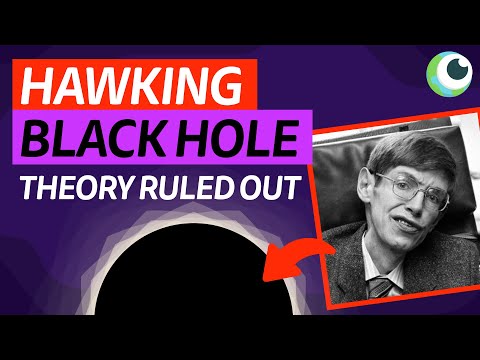
Stephen Hawking theory about black holes and dark matter is RULED OUT
- But observations show that most stars have a similar orbit speed around their galactic disk, however close or far out they are, which implies that there is some gravitational force at work that we can't see and so far don't understand.
But observations show that most stars have a similar orbit speed around their galactic disk, however close or far out they are, which implies that there is some gravitational force at work that we can't see and so far don't understand.
- But observations show that most stars have a similar orbit speed around their galactic disk, however close or far out they are, which implies that there is some gravitational force at work that we can't see and so far don't understand.
But observations show that most stars have a similar orbit speed around their galactic disk, however close or far out they are, which implies that there is some gravitational force at work that we can't see and so far don't understand.
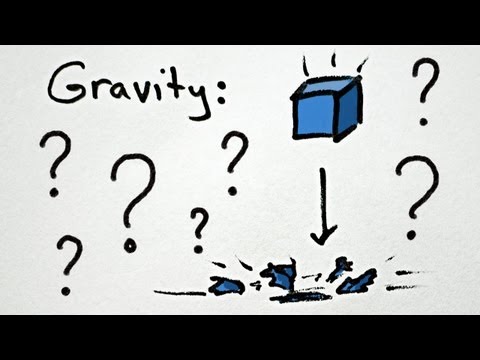
Minute Physics: What is Gravity?
- In the 17th century, Isaac Newton discovered that the strength of the gravitational force
In the 17th century, Isaac Newton discovered that the strength of the gravitational force
- In the 17th century, Isaac Newton discovered that the strength of the gravitational force decreases by the square of the distance between two objects, so if you're twice as far away, gravity is only one-fourth as strong.
In the 17th century, Isaac Newton discovered that the strength of the gravitational force decreases by the square of the distance between two objects, so if you're twice as far away, gravity is only one-fourth as strong.
Friday Night Fights with Neil deGrasse Tyson

- AN UNPARALLELLED GRAVITATIONAL FORCE, RIGHT?
AN UNPARALLELLED GRAVITATIONAL FORCE, RIGHT?
- An unparalleled gravitational force, right?
An unparalleled gravitational force, right?
Baseball Aerodynamics

- and consider only the gravitational force on the ball
and consider only the gravitational force on the ball
How High Can We Build?
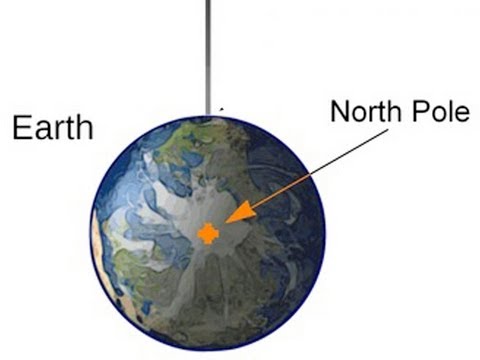
- If a structure was so tall that it wound up at the altitude of a geostationary orbit, it would start to feel a new force, not just a gravitational force downward, but all of a sudden this new centrifugal force up and outward.
If a structure was so tall that it wound up at the altitude of a geostationary orbit, it would start to feel a new force, not just a gravitational force downward, but all of a sudden this new centrifugal force up and outward.
- it would start to feel a new force, not just a gravitational force downward, but, all of
it would start to feel a new force, not just a gravitational force downward, but, all of
Timothee Chalamet ( The Tonight Show Starring Jimmy Fallon)

- for the Q&A, and then a gravitational force
for the Q&A, and then a gravitational force
- and then a gravitational force comes out of nowhere and knocks me out of the chair,
and then a gravitational force comes out of nowhere and knocks me out of the chair,
Newton's Laws: Crash Course Physics #5

- And probably the most common case of a net force making something move is the gravitational force.
And probably the most common case of a net force making something move is the gravitational force.
- And probably the most common case of a net force making something move is the gravitational force.
And probably the most common case of a net force making something move is the gravitational force.
Why Doesn't Time Flow Backwards? (Big Picture Ep. 1/5)

- but when the density of matter is extremely high, the gravitational force between particles is enormous.
but when the density of matter is extremely high, the gravitational force between particles is enormous.
- density of matter is extremely high, the gravitational force between particles is enormous.
density of matter is extremely high, the gravitational force between particles is enormous.